 English
What is the purpose of an orthogonal compound machine?
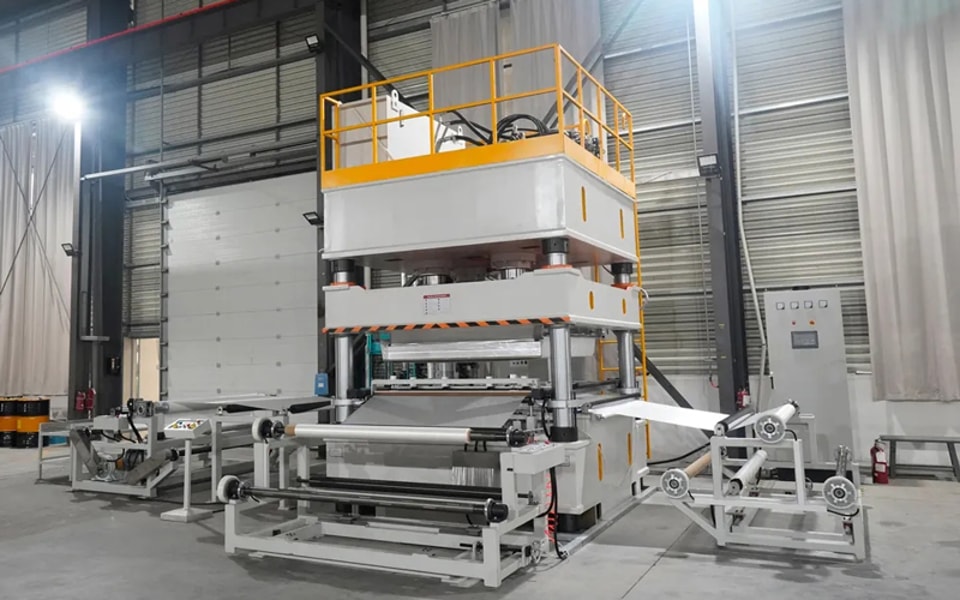
An orthogonal composite machine is specialized equipment designed to cross-lay and bond fibers, fabrics, or reinforcement materials arranged in different directions. Its primary objective is to enhance the mechanical properties, dimensional stability, and overall performance of composite materials through an orthogonal structural design. Unlike materials with unidirectional alignment, orthogonally composited products can withstand loads in both longitudinal and transverse directions, ensuring more uniform stress distribution; consequently, they are widely used in sectors such as high-performance fibers, composite materials, industrial fabrics, protective materials, and engineering reinforcements.
First, the most significant function of the orthogonal composite machine is to improve the material's comprehensive mechanical properties. While unidirectionally aligned fibers offer high strength in a single direction, their transverse performance is relatively weak, making them prone to deformation or rupture under complex external forces. By cross-laying fibers at perpendicular or specific angles, the machine creates a balanced load-bearing structure across multiple directions. This significantly boosts tensile strength, tear resistance, impact resistance, and fatigue resistance, thereby meeting more demanding application requirements.
Second, the orthogonal composite machine enhances dimensional stability. In practical applications, many materials are susceptible to shrinkage, elongation, or deformation caused by mechanical stress, temperature fluctuations, or humidity changes. Through orthogonal compositing, fibers oriented in different directions mutually constrain one another, effectively minimizing the tendency for deformation and improving overall dimensional stability. This is crucial for sectors requiring high precision, such as aerospace, automotive manufacturing, construction engineering, and industrial equipment.
Third, the equipment enables efficient composite processing involving diverse materials. Beyond simply cross-laying fibers, it allows for the multi-layer lamination of fabrics, non-wovens, films, reinforcement grids, and other functional materials to create structures with multifaceted properties. For instance, high-strength fibers can be combined with wear-resistant, waterproof, or flame-retardant layers—or functional films—to produce a final product that simultaneously offers high strength, wear resistance, waterproofing, and flame retardancy, thereby further expanding the material's range of applications.
Finally, the orthogonal composite machine improves the uniformity of stress distribution within the material. Because fibers are evenly distributed in both longitudinal and transverse directions, external forces—whether tensile, compressive, bending, or impact loads—are dispersed across multiple directions, preventing localized stress concentrations. This not only enhances the material's load-bearing capacity but also extends the product's service life. This advantage of uniform stress distribution is particularly significant for products subjected to long-term cyclic loads, such as industrial conveyor materials, protective gear, and structural engineering components.
Furthermore, orthogonal laminating machines effectively improve product consistency and processing precision. Modern equipment typically employs systems for automatic tension control, material feeding, positioning, and synchronized lamination; these allow for precise control over fiber orientation angles, interlaminar positioning, and composite thickness, thereby minimizing deviations caused by human error. Whether in batch or continuous production, high consistency is maintained, resulting in higher product pass rates and reduced material waste.
Orthogonal laminating machines also offer distinct advantages in terms of production efficiency. Traditional manual layup methods are not only inefficient but also struggle to ensure uniform fiber alignment. Automated orthogonal lamination equipment enables the continuous execution of multiple processes—including feeding, layup, positioning, lamination, and winding—significantly shortening production cycles and increasing equipment utilization rates. Additionally, automated control reduces labor intensity and costs, thereby boosting overall production efficiency.
With the advancement of high-performance composite materials, orthogonal laminating machines play an increasingly vital role in the manufacturing of functional materials. For instance, when processing materials such as high-performance polyethylene, aramid, carbon, and glass fibers, the orthogonal lamination process fully leverages the fibers' inherent high strength and high modulus, resulting in materials with superior overall performance. Moreover, layup angles, the number of layers, and composite structures can be customized to meet specific product requirements, enabling tailored processing and enhancing product versatility.
The orthogonal lamination process also minimizes material waste and maximizes raw material utilization. The equipment precisely controls material placement and lamination width based on preset parameters, preventing the misalignment, overlapping, or waste often associated with manual layup. This not only lowers production costs but also supports green manufacturing and the efficient use of resources.
Modern orthogonal laminating machines are also commonly equipped with intelligent control systems that monitor operating speed, tension, layup precision, and production status in real-time, triggering alarms for anomalies and automatically adjusting parameters. This ensures production stability, further enhances product quality and equipment efficiency, and provides a reliable foundation for continuous, large-scale production. Overall, the primary objective of the orthogonal composite machine is to enhance the mechanical properties, dimensional stability, impact resistance, and comprehensive performance of materials through scientifically optimized fiber cross-layering and multi-layer composite processing, while simultaneously enabling automated, high-efficiency, and high-precision production. With the continuous advancement of composite material technology, the orthogonal composite machine has become indispensable equipment in the manufacturing of modern high-performance fibers and advanced composite materials, providing stable, high-quality composite material solutions across various industrial sectors.


